Absorption Is the Constraint
A transformation is paced by what the organization can absorb—not by what's technically possible, or even technically ready.
Phase 1 looked like a book-management fix. That was deliberate.
You cannot pitch a transformation in a vacuum. You need an outcome people can see and fund—and ours was concrete: take a delivery process that ran close to ten days and bring it under one.
That was the anchor. It was what engineering and the business understood Phase 1 to be, and I did not fight that framing. It was true, valuable, and fundable.
But underneath the book-management story, I was designing something broader: a client-centric architecture modeled across sales, service, and support operations—the whole shape, not only the slice we were shipping.
Most of that broader design had no immediate value to point to yet, so there were not many listeners for the argument. The hard part was designing for a future the organization couldn't yet see the value in. I had to hold that shape while delivering the outcome directly in front of us.
Which is why Phase 2 was the moment it came due.
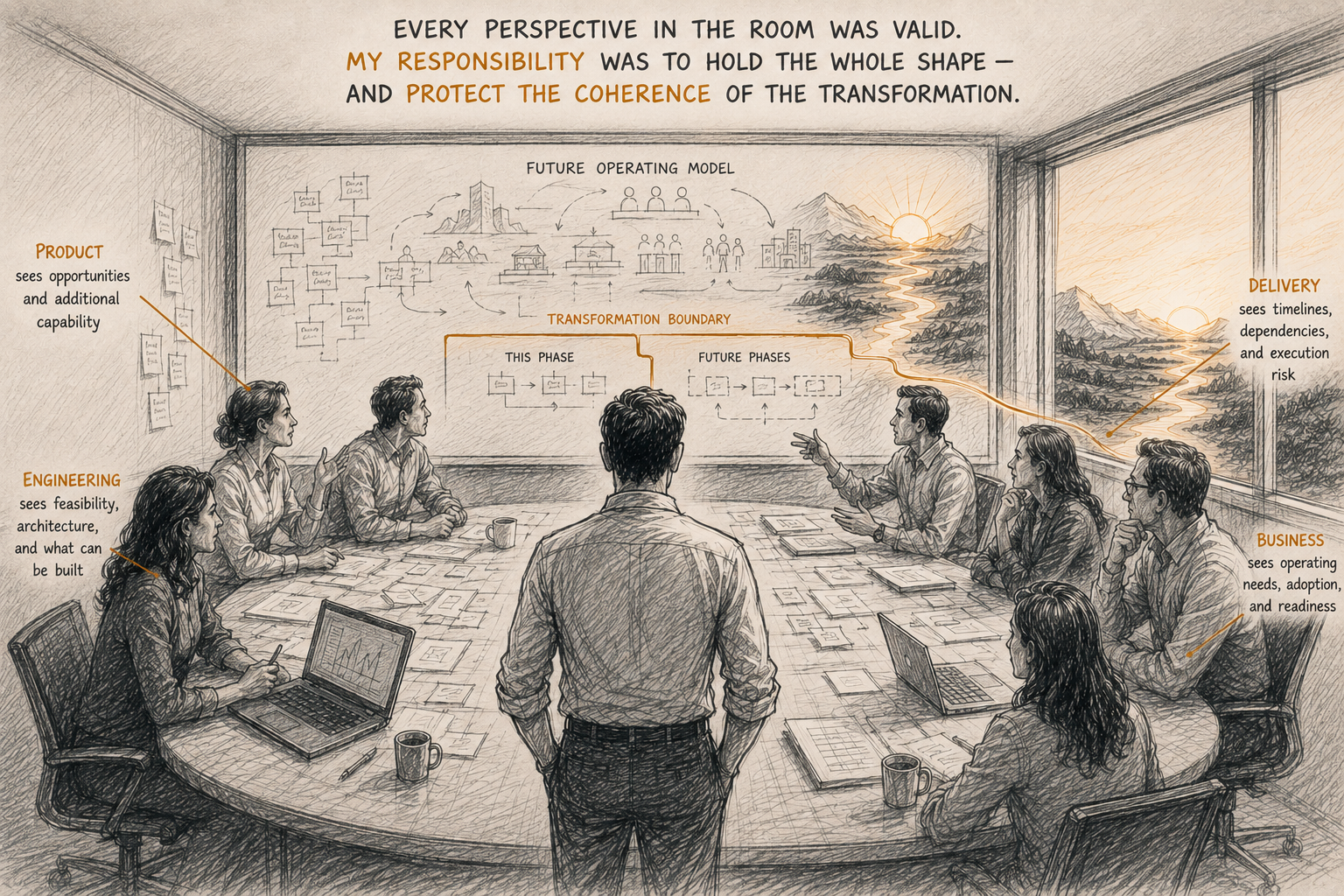
We gathered to scope it—twenty to twenty-five of us: product leaders, engineering directors, program leaders, and architects and engagement managers from the implementation partner.
The pressure was to transform more while we had the momentum: forecasting, quoting, and the adjacent processes. The concern was legitimate—were we doing enough to deliver the business value the transformation could unlock? Every one of those was a real opportunity. Every advocate was right that it mattered.
Every perspective in that room was valid. Product saw additional value. Engineering saw what was buildable. Delivery saw execution risk. The business saw what it still needed. Each understood the part they owned.
My responsibility was different. I was holding the whole shape—the destination, the architecture beneath it, what the business could absorb, and the seams no single perspective could see alone. The boundary did not come from authority or from owning the program. It came from being responsible for protecting the coherence of the transformation while judging those realities together.
That was what allowed me to stand at the whiteboard and hold the line—not caution, but clarity about what the transformation had to preserve.
The date was fixed. More scope would not create more time or more readiness. It would put the foundation we were trying to land at risk.
The business was aligned around the transformation in that moment. That alignment was perishable. The next phase had to go live stable—not fractured by trying to change everything at once.
We had only a few months to go live on a foundation that would touch many layers of the business. Readiness was not a detail. It was the whole game.
It went for hours. It got heated.
The Separation Principle
The separation was clear to me: if it did not change where we were going, it could wait. But if the process had to fit into the new operating model—the new way the business needed to think and work—it had to be designed into the transformation now.
The line was not between important and unimportant work. Every idea in the room mattered. The line was between what the foundation needed now and what could be sequenced later without changing the architecture or weakening the vision.
We drew the line. Every product director agreed it was the right path.
The Thesis
That decision is the whole subject of this piece.
Enablement Is Not Absorption
Enabling a capability is not transforming the business.
Giving a team a feature is one thing. Changing how they think, make decisions, manage ownership, and operate end to end is something else entirely.
The architecture can be ready before the business is ready to absorb what it makes possible.
That is not always resistance. Sometimes it's a valid response to uncertainty—especially when the change affects revenue, customer relationships, contracting, or the way work has been managed for years.
One business area illustrated this clearly. In Phase 1, we created the architectural foundation for a very different operating model.
The business had previously managed much of the work through paper-based processes and familiar local practices. The new model was possible, but the organization wasn't yet comfortable operating inside it.
The transformation didn't happen simply because the capability existed. It required working with stakeholders across the business, helping them see how they could operate differently, and building the surrounding processes—relationship management, onboarding, contracting, forecasting.
Over time, the value became tangible. Contracting began moving from paper into the platform. Onboarding became more structured. Forecasting became possible. The tooling could support more flexible business structures.
One region moved first. Others are still progressing.
The capability was enabled. The transformation is still being absorbed.
That gap—between what technology has enabled and what the organization is ready to own—is absorption debt. Usage is not absorption. People can use a system every day while the organization still thinks in the old model—routing around the new process, keeping the old workarounds. The tool is used; the change has not been absorbed.
When the technology is live but the organization hasn't truly taken it on, the gap doesn't stay empty. It fills with workarounds, manual reconciliation, and a dependency on the few people who understand how the pieces connect.
And it's easy to misread as resistance. Sometimes the organization isn't resisting—it's compensating for a transformation whose meaning or ownership was never fully closed.
Absorption debt doesn't always mean the architecture was wrong. Sometimes the foundation has to be established before the business can see the possibilities. The debt is paid down as understanding, confidence, and ownership catch up.
But not every idea should be enabled first and absorbed later.
Some changes—transforming forecasting, or introducing more complex quoting models—require a deeper understanding of the opportunity-to-cash process, the business levers involved, and the operating decisions that have to change around them.
They may be strategically sound. The architecture may already leave room for them. But if the business isn't ready to prioritize and own the transformation, forcing them into the current phase creates debt without creating durable value.
In those cases, the better decision is deliberate deferral. As long as the architecture doesn't constrain the future path, the capability can follow quickly when the business is ready to do the work around it.
The distinction is not between transformation and no transformation. It's between two responsible paths:
Build the foundation now when doing so unlocks the future—then help the organization absorb it by driving alignment across business verticals, on a realistic timeline.
Or preserve the architectural path and defer the change until the business is ready to transform the process around it.
The mistake is assuming technical availability and business readiness arrive together. They don't.
The architecture can be ready before the business is—built to let the business scale into new models and processes when it's ready, without the technology holding it back.
The Real Transformation Surface
Two changes can look the same in a technical estimate and be completely different for the business to absorb.
One may change a workflow inside one team. Another may shift ownership across functions or force old and new models to run side by side. The second is harder to absorb.
That is why technical size alone cannot sequence a transformation. The organizational seams matter too—the same point I make in Local Optimization Is Not Enterprise Transformation.
Architectural Restraint Is Not a Lack of Ambition
Restraint is part of the design. Each phase has to be whole enough for the organization to carry—not a set of fragments people have to bridge with spreadsheets and workarounds.
Architectural restraint is not the act of saying no to change. It's the act of protecting change from becoming incoherent.
It serves the vision by keeping the core principles intact and the business moving toward where it needs to go.
Sequence for Ownership, Not Throughput
A release plan answers when software will ship. A transformation sequence answers when the organization will be ready to carry the next layer of change. Related timelines—not the same one.
Each phase should create a complete ownership loop: the organization experiences the new model, operates it under real conditions, finds where assumptions fail, stabilizes the seams, and takes ownership before the next layer is added. The goal isn't to move at the pace of the fastest delivery team.
It's to move at the pace at which the critical seams can become stable and owned.
The clearest case was forecasting—and the multi-line opportunity and quoting model connected to it.
Everyone could see that the capability was valuable, and the platform could support it. The pressure was to enable it now: the feature exists, the industry works this way, so turn it on.
But when I looked closely, I did not yet understand why the business operated the way it did. We were modeling from industry patterns, and almost every step forward exposed another assumption.
We had assumed, for example, that an opportunity should be created for every sales motion.
A closer analysis showed that the business was more nuanced than that. We had not yet done enough work to hold a defensible point of view—
and if you cannot clearly explain why the process must change, you have not earned the right to ask the business to change it.
There was a deeper problem underneath.
Enabling the feature and transforming the process were not the same thing.
"The platform supports it, so let's use it" starts from the tool.
It skips the harder questions: Why does the business operate this way today? Which parts genuinely need to change? And what else moves when they do?
Forecasting and quoting do not sit in isolation. They connect to how the company goes to market, how its selling motions are structured, and how monetization, fulfillment, and billing operate.
Changing one part in the middle, without understanding those connections, would not have produced the outcome anyone expected.
So we deferred it—deliberately.
Not because it lacked value, but because we had not yet earned the understanding required to transform it.
The architecture left room for the capability. Once we had a defensible view of the end-to-end process, and the business was ready to prioritize and own the change, it could fast-follow.
Transforming a process you do not yet understand, simply because a feature exists or the industry uses it, is a recipe for transformation failure.
“Not in This Transformation” Is a Strategic Decision
Some architectural decisions prevent a bad deliverable instead of producing a new one.
“Not in this transformation” does not mean “not valuable.” It means the idea is not ready to enter this phase.
A clear boundary protects the deferred idea too. It can be examined on its own terms instead of being forced into a program that was never designed to hold it.
The Architect Regulates the Rate of Change
In a transformation, the architect regulates how quickly the operating model gets rewritten. The path runs on organizational time, not delivery time.
The job is to decide what changes now, what stays stable for a while, and what remains outside the boundary.
Looking back, the boundary was not simply a scope decision. It came from holding the destination and the realities around it in one frame—a way of seeing the transformation that I have since tried to make explicit.
The IC Architect’s Transformation Playbook covers the altitude shifts behind that judgment.
How Do You Know It's Been Absorbed?
Not when the last feature ships. Not when the old system is turned off. Not when training is complete. Not even when adoption metrics show the new workflow is being used.
A transformation is absorbed when the new capability becomes ordinary. The business can explain how it works and why it exists. Exceptions have owners. Data carries shared meaning across boundaries. And the transformation team is no longer required to translate every disagreement or reconnect every seam.
Technical enablement ends at go-live. Business transformation ends when the capability can be carried by the organization itself.
Durable Change
Transformation is often praised for breadth and speed. But the highest form of ambition isn't maximal change. It's durable change—leaving the organization with a capability clearer, stronger, and more adaptable than the one it replaced.
That takes judgment. The confidence to include work that closes an essential seam even when it isn't visually impressive—and the restraint to leave good ideas outside the boundary when the organization isn't ready to own their consequences.
The hardest architectural decision is often knowing what not to transform.
Five months later, the program went live as planned, with no business disruption.